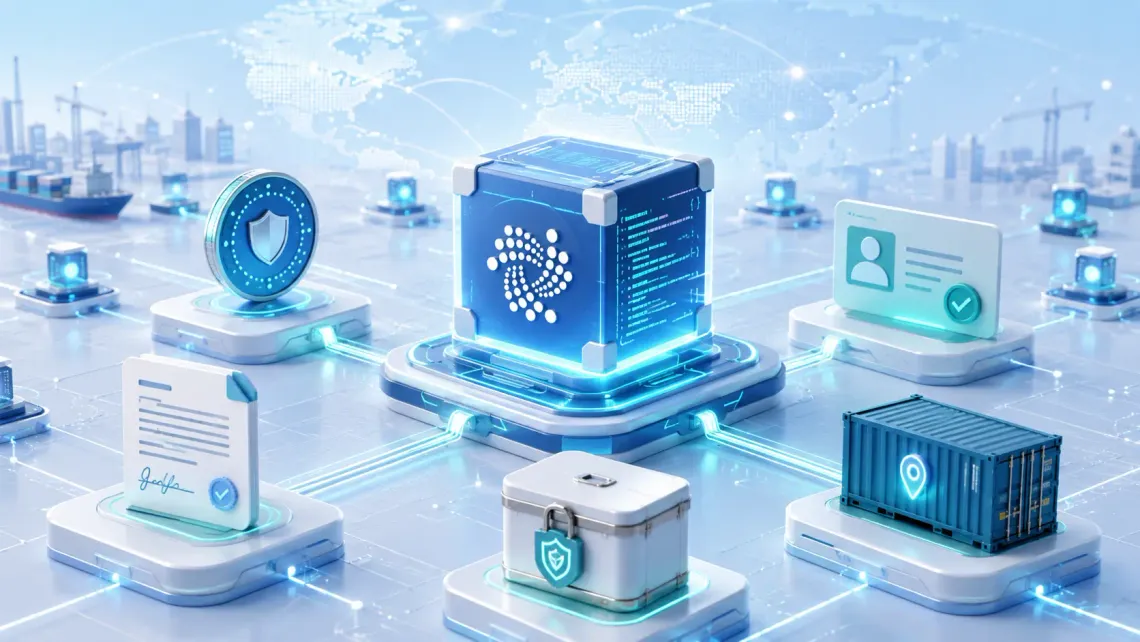
Global trade is one of the most important engines of economic growth, yet the systems behind it remain surprisingly outdated. Many international trade processes still depend on paper documents, manual checks, fragmented databases, and slow coordination between exporters, importers, customs authorities, logistics providers, banks, insurers, and certification bodies.
Every shipment can involve dozens of documents and multiple institutions across different countries. Certificates of origin, invoices, customs declarations, logistics records, compliance documents, and financing data must be issued, verified, accepted, and trusted. When this process is paper-based or disconnected, trade becomes slower, more expensive, less transparent, and harder to scale.
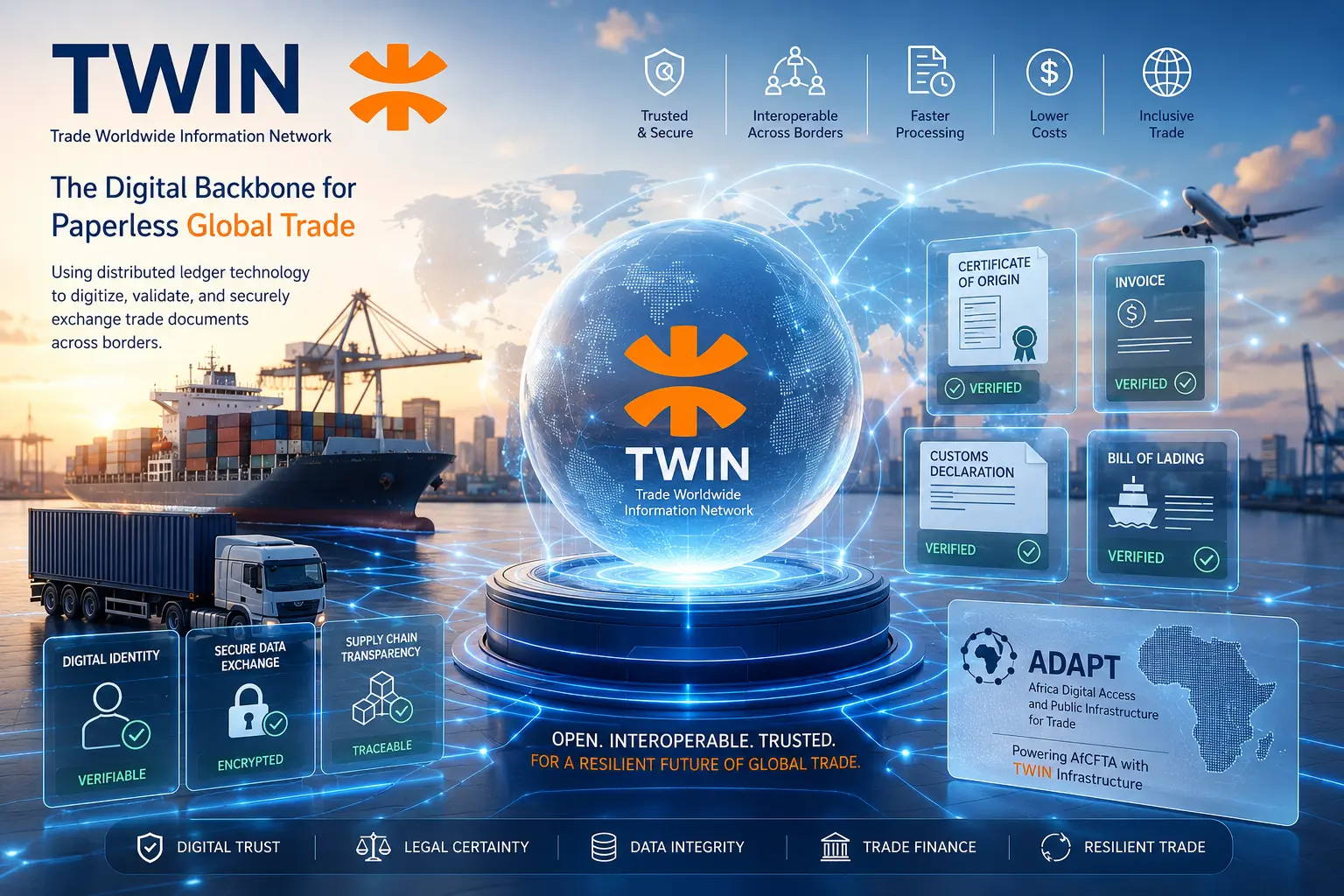
This is where the Trade Worldwide Information Network, known as TWIN, becomes highly relevant. TWIN is designed as a next-generation, open-source digital public infrastructure for global trade. Its goal is to unlock paperless, trusted, and interoperable trade by using distributed ledger technology to digitize and validate core trade documents across borders.
TWIN is not just another trade software platform. It represents a broader shift toward trusted digital trade infrastructure, where documents, identities, shipments, and compliance records can be verified securely and efficiently. For global commerce, this could be a major step toward lower costs, shorter processing times, stronger data integrity, and more inclusive access for small and medium-sized enterprises.
Why Global Trade Needs a New Digital Infrastructure
International trade has become more digital in many areas, but the underlying infrastructure is still fragmented. A shipment may begin with an exporter in one country, move through logistics providers, require customs clearance in another jurisdiction, involve banks or insurers, and end with an importer in a different market. Each participant may use its own system, format, database, or document process.
This creates friction. Documents can be duplicated, delayed, lost, submitted incorrectly, or even falsified. Trade partners often need to manually verify information that should already be trusted. Customs authorities must process large volumes of data from different sources. Banks and funders need reliable documentation before financing transactions. Smaller companies often struggle because they lack the resources to navigate complex paper-based systems.
The result is a global trade environment where information does not move as efficiently as goods. Containers can travel across oceans faster than documents are checked and approved. This slows down supply chains, increases costs, and creates unnecessary barriers for businesses.
TWIN addresses this challenge by creating a trusted digital backbone for trade information. Instead of relying on isolated paper documents or closed private platforms, TWIN enables trade data to become verifiable, interoperable, and usable across multiple organizations and jurisdictions.
What Is TWIN?
TWIN stands for Trade Worldwide Information Network. It is an open-source digital public infrastructure initiative focused on modernizing global trade through trusted data exchange.
At its core, TWIN is designed to help trade participants digitize, validate, and exchange important trade documents in a secure and interoperable way. These documents can include certificates of origin, invoices, customs declarations, shipment records, compliance documents, and other data required for cross-border trade.
The key idea behind TWIN is that global trade needs a neutral trust layer. Businesses, governments, logistics providers, and financial institutions need to verify information without depending on one central platform or one single commercial operator. TWIN supports this by using distributed ledger technology, decentralized identity, and verifiable data structures.
This makes TWIN especially relevant for paperless trade, supply chain transparency, customs modernization, trade finance, and digital public infrastructure.
How Distributed Ledger Technology Supports Paperless Trade
Distributed ledger technology, or DLT, plays an important role in TWIN because it allows information to be verified without relying on a single central authority. In global trade, this is extremely valuable.
A trade document is only useful if other parties can trust it. A certificate of origin must be trusted by customs. An invoice must be trusted by buyers, sellers, and financial institutions. A customs declaration must be trusted by border authorities. A shipment record must be trusted by logistics partners and insurers.
With DLT, proof of a document's existence, origin, integrity, and status can be anchored in a tamper-resistant way. This does not necessarily mean that all business data becomes public. Instead, the system can provide cryptographic proof that a document or credential is valid, while sensitive information remains controlled by the relevant parties.
This is a major advantage for global trade. It allows participants to verify information faster, reduce manual checks, and strengthen confidence across borders.
Digitizing Core Trade Documents
TWIN can support the digitization and validation of important trade documents such as certificates of origin, invoices, customs declarations, logistics records, and compliance documents.
These documents are essential for international trade. They prove where goods come from, what is being shipped, who is involved, which regulations apply, and whether the shipment meets legal requirements. When these documents are paper-based, verification becomes slow and inefficient.
By turning them into digitally verifiable records, TWIN can help reduce delays, lower administrative costs, and improve transparency. A document does not need to be checked again and again manually if its authenticity and integrity can be verified through trusted digital infrastructure.
Improving Data Integrity and Traceability
Data integrity is one of the biggest challenges in global trade. If information is incomplete, outdated, duplicated, or manipulated, the entire supply chain can be affected.
TWIN helps address this by making trade data more traceable and verifiable. Participants can see whether documents were issued by trusted parties, whether they have been changed, and whether they are connected to the correct shipment or transaction.
This improves trust between trading partners. It also helps customs authorities, banks, insurers, and logistics providers make faster and more reliable decisions.
Transparency Without Losing Data Control
One of the most important principles for digital trade infrastructure is the balance between transparency and data sovereignty.
Businesses need to share information, but they also need to protect sensitive commercial data. Governments need visibility, but they also need systems that respect legal and privacy requirements. Trade partners need trust, but not every participant should see every detail of a transaction.
TWIN can support this balance by enabling selective verification. Participants can prove that a document, credential, or data point is valid without exposing unnecessary information. This is where decentralized identity and verifiable credentials become especially important.
A company can prove that it is registered. A document can prove that it was issued by a recognized authority. A shipment can prove that it meets specific compliance requirements. But the system does not need to expose all private business data to everyone.
This approach makes TWIN more suitable for real-world trade than simple public data publishing. It supports trust, while still respecting confidentiality and control.
Why Interoperability Matters
Global trade cannot be modernized through isolated platforms. There are too many countries, agencies, companies, legal systems, and technical environments involved. A closed system may work for one corridor or one company, but it cannot solve the wider problem of global trade fragmentation.
TWIN focuses on interoperability. This means different systems can connect, exchange information, and verify data without needing to become part of one single platform. For trade, this is essential.
Customs systems, logistics platforms, banking tools, digital identity systems, and compliance databases must be able to communicate. Without interoperability, digitization simply creates new silos.
TWIN's open-source and infrastructure-oriented approach makes it especially important. It can act as a shared digital layer that connects different participants while allowing them to keep their own systems and processes.
Benefits for SMEs and Developing Economies
Small and medium-sized enterprises often face the greatest barriers in international trade. They may not have dedicated compliance departments, expensive software systems, or strong relationships with banks and logistics providers. Paper-based processes can make it harder for them to export, receive financing, or enter new markets.
TWIN can help reduce these barriers by making trade documentation easier to verify and share. If SMEs can provide trusted digital documents, they may face fewer delays and lower administrative costs. They may also be better positioned to access trade finance because funders can verify documents and transaction data more efficiently.
For developing economies, this is especially important. Many countries have strong trade potential but are limited by fragmented infrastructure, slow customs procedures, and low trust in documentation. Digital public infrastructure like TWIN can help create more reliable trade corridors and improve access to regional and global markets.
Lower Costs
Paper-based trade creates costs at every step. Documents must be prepared, printed, couriered, checked, corrected, stored, and sometimes reissued. Errors can cause delays, penalties, storage fees, and missed delivery windows.
By digitizing and validating documents, TWIN can reduce administrative friction and lower the cost of cross-border trade.
Shorter Processing Times
When trade documents are digitally verifiable, customs authorities and trade partners can process information more quickly. This can reduce waiting times, speed up border procedures, and make supply chains more predictable.
Better Access to Finance
Trade finance depends on trust. Banks and funders need reliable documents before they provide capital. If invoices, shipment data, and compliance records can be verified digitally, financing decisions can become faster and less risky.
This can be especially valuable for SMEs that struggle to access traditional trade finance.
TWIN and Trade Resilience
Recent years have shown that global trade is vulnerable to disruption. Pandemics, port congestion, geopolitical tensions, cyber risks, regulatory changes, and climate-related events can all affect the movement of goods.
Resilient trade requires more than ships, roads, ports, and warehouses. It also requires resilient data infrastructure.
When trade systems depend on paper documents and fragmented records, recovery from disruption becomes slower. Participants may not know which shipments are affected, which documents are missing, or which approvals are still valid. This creates uncertainty and delays.
TWIN can strengthen resilience by improving access to trusted trade data. If documents, shipment records, and compliance information are digitally verifiable, trade participants can respond faster when disruptions occur. They can identify affected shipments, verify document status, reroute goods, and restore operations with greater confidence.
This makes TWIN important not only for efficiency, but also for continuity. In a disrupted world, reliable trade data becomes a strategic asset.
ADAPT: A Regional Example of TWIN-Based Infrastructure
A concrete example of TWIN's potential is ADAPT, the Africa Digital Access and Public Infrastructure for Trade initiative. ADAPT is a TWIN-based implementation designed to support the African Continental Free Trade Area, known as AfCFTA.
AfCFTA is one of the most ambitious trade projects in the world. It aims to create a more integrated African market, strengthen regional value chains, reduce barriers to trade, and increase economic cooperation across the continent.
But to unlock the full potential of AfCFTA, Africa needs more than trade agreements. It needs digital infrastructure that can support identity, data exchange, payments, compliance, logistics, and trade finance across borders.
ADAPT addresses this need by applying TWIN-based digital public infrastructure at regional scale.
Supporting Digital Identity
Digital identity is essential for trusted trade. Businesses, logistics providers, customs brokers, documents, and even shipments need to be identifiable and verifiable.
ADAPT can support digital identity by allowing participants to prove who they are and what role they play in a trade transaction. This reduces fraud, improves compliance, and makes onboarding easier for companies operating across borders.
Enabling Trusted Data Exchange
Trade depends on data. Certificates, invoices, customs records, logistics updates, and compliance documents must move between many parties.
ADAPT can help create trusted data exchange across African markets by using TWIN infrastructure to make trade data verifiable and interoperable. This can reduce duplication, improve transparency, and support faster cross-border processes.
Strengthening Inclusive Trade
One of the most important goals of ADAPT is inclusion. Many African SMEs face barriers when trying to participate in regional or international trade. Complex documentation, slow border processes, limited digital identity, and weak access to finance can prevent smaller businesses from scaling.
By reducing friction and creating trusted digital rails, ADAPT can help more businesses participate in AfCFTA-driven trade.
Why TWIN Matters for AfCFTA
AfCFTA is not only a trade agreement. It is a long-term economic integration project. For it to succeed, African markets need systems that make cross-border trade easier, faster, and more trustworthy.
TWIN-based infrastructure can support this by modernizing trade processes and improving interoperability between countries. Instead of every country or institution operating in isolation, trusted digital infrastructure can help connect different systems.
This matters for customs modernization, regional supply chains, digital payments, trade finance, and regulatory compliance. It also supports Africa’s broader digital economy by creating infrastructure that can be reused across sectors.
ADAPT shows how TWIN can move from a global concept to a practical regional implementation. It demonstrates how open-source digital public infrastructure can support real economic development.
Why This Matters for IOTA
TWIN is highly relevant for the IOTA ecosystem because it shows how distributed ledger technology can be used for real-world infrastructure. Instead of focusing only on speculative crypto use cases, TWIN applies DLT to one of the most important areas of the global economy: trade.
IOTA's role in this context is about digital trust. Global trade needs secure data, verifiable documents, decentralized identity, reliable settlement, and scalable infrastructure. These are all areas where IOTA's technology stack can provide value.
TWIN, ADAPT, and related projects such as TLIP show how IOTA can become part of the digital foundation for trade, supply chains, customs processes, and trade finance.
This is especially important for the future of real-world assets. Trade documents, invoices, bills of lading, warehouse receipts, certificates, and compliance records can all become digitally verifiable assets. Once these assets are trusted, they can support new forms of financing, automation, and liquidity.
In this way, TWIN connects several major themes: digital trade, decentralized identity, RWA tokenization, trade finance, supply chain transparency, and public digital infrastructure.
From Paperless Trade to Programmable Trade
The first step in trade digitalization is paperless trade. Documents become digital. Verification becomes faster. Manual processes are reduced.
But the larger transformation goes further. Once trade data is digital, trusted, and interoperable, trade can become programmable.
Smart contracts can automate parts of payments, compliance, financing, and settlement. Verifiable credentials can prove the status of companies, documents, goods, and shipments. Tokenized trade assets can connect physical commerce with digital capital markets. Customs processes can become faster and more data-driven.
This does not mean that regulation disappears. In fact, trusted digital trade infrastructure must work with legal frameworks, customs authorities, banks, and international standards. The goal is not to remove institutions from trade. The goal is to give them better infrastructure.
TWIN provides a foundation for this future by focusing on trust, interoperability, resilience, and open infrastructure.
The Role of APTFF x PTW 2026
The discussion around TWIN is especially relevant in the context of APTFF x PTW 2026, co-organized by the Asian Development Bank and the United Nations Economic and Social Commission for Asia and the Pacific, in collaboration with the World Economic Forum.
The event focuses on the next generation of trade digitalization, trust, sustainability, and cross-border interoperability. This makes it a strong platform to present TWIN as a practical example of how digital public infrastructure can support global trade modernization.
By showcasing TWIN and ADAPT, the session highlights both the global and regional potential of DLT-enabled trade infrastructure. TWIN provides the broader digital backbone, while ADAPT demonstrates how that backbone can be applied to support AfCFTA and inclusive trade across African markets.
This combination is important because the future of trade digitalization will depend on both global standards and regional implementation.
Conclusion: TWIN as a New Trust Layer for Global Trade
TWIN represents a major step toward a more modern, resilient, and inclusive global trade system. By using distributed ledger technology to digitize and validate trade documents, TWIN can reduce paper dependency, improve transparency, strengthen legal certainty, and make cross-border trade more efficient.
The value of TWIN is not only technical. It is economic and institutional. It can lower costs, shorten processing times, improve data integrity, support SMEs, and help developing economies participate more fully in global commerce.
ADAPT shows how this infrastructure can be applied at regional scale to support AfCFTA. By connecting digital identity, trusted data exchange, interoperable systems, and inclusive trade infrastructure, ADAPT illustrates how TWIN can move from concept to real-world implementation.
For IOTA, TWIN is one of the clearest examples of how decentralized infrastructure can serve the real economy. It connects blockchain technology with global trade, public infrastructure, digital identity, and verifiable data.
The future of trade will not be built only with ports, ships, trucks, and warehouses. It will also depend on trusted data, digital identity, interoperable networks, and resilient infrastructure.
TWIN may become one of the key digital backbones that helps global trade move from paper-based processes to trusted, paperless, and programmable commerce.