From Paper Certificates to Verifiable Digital Trust
Certificates play an important role in education, healthcare, employment, compliance, renewable energy, and international business. They prove that a person completed a course, holds a professional licence, meets a regulatory requirement, or possesses a specific qualification.
However, many credentials are still distributed as paper documents, scanned files, or PDFs attached to emails. These formats may look official, but they are difficult to verify independently. Employers, universities, regulators, and business partners often have to contact the original issuer manually before they can trust a document.
This creates delays, administrative costs, and opportunities for fraud.
Turing Space aims to replace this fragmented process with machine-verifiable digital trust. Its Turing Certs platform allows organizations to issue, manage, share, and verify digital credentials across borders and industries.
The integration of IOTA adds a public, independently verifiable infrastructure layer beneath this system.
What Is Turing Certs?
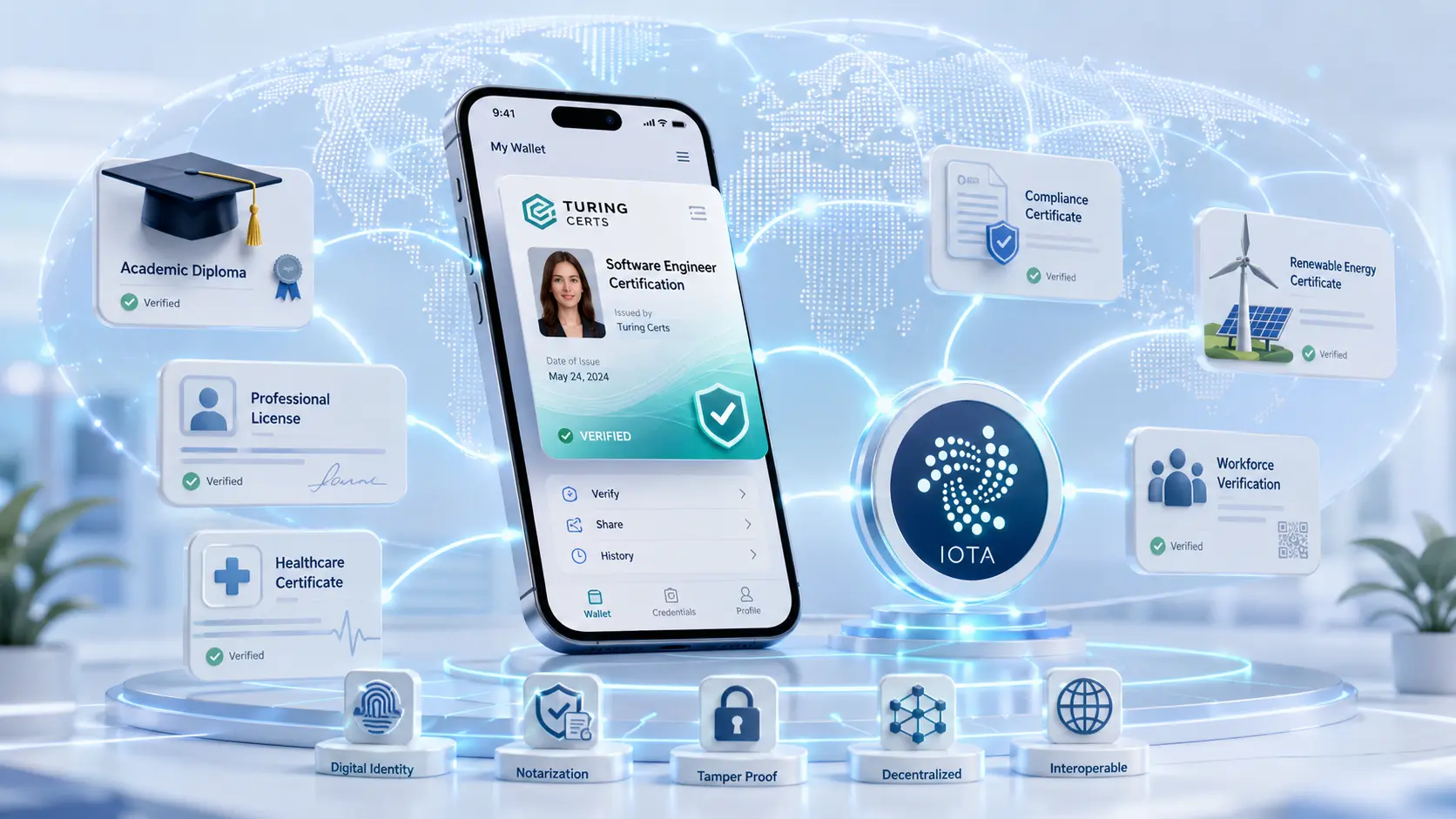
Turing Certs is a digital credential platform developed by Turing Space. It can be used for academic diplomas, training records, professional certificates, licences, employee credentials, healthcare records, renewable energy certificates, and compliance evidence.
The platform connects three main groups:
Issuers
Issuers are organizations that create credentials. These may include universities, employers, government institutions, professional associations, energy authorities, or healthcare organizations.
Holders
Holders are the individuals or organizations receiving the credential. They can store and present it when applying for employment, accessing services, proving qualifications, or completing a compliance process.
Verifiers
Verifiers are the parties checking whether a credential is authentic. Instead of relying on a PDF or contacting the issuer manually, they can inspect the credential’s cryptographic proof.
This changes verification from an email-based process into a digital trust system.
How IOTA Supports Turing Certs
Turing Certs uses several components of the IOTA technology stack. Each component solves a different part of the digital credential problem.
IOTA Identity
Every credential ecosystem needs reliable identities for issuers, holders, and verifiers.
Turing Certs uses decentralized identifiers, commonly known as DIDs, through IOTA Identity. A DID allows an organization or individual to prove control over a digital identity without depending entirely on one central database.
Credentials can then be issued as verifiable credentials linked to these identities.
For example, a university can issue a diploma connected to its verified digital identity. An employer can check who issued the diploma and whether the credential is still valid.
IOTA Notarization
A digital credential must remain trustworthy after it has been issued.
Turing Certs uses IOTA Notarization to anchor credential proofs to the IOTA ledger. This creates a timestamped record that can be independently checked.
The original document does not need to be published openly onchain. Instead, a cryptographic proof can be recorded. If the document is changed later, the new version will no longer match the original proof.
This allows a verifier to check integrity without requiring access to confidential data.
IOTA Gas Station
Blockchain systems can create unnecessary friction when users must purchase tokens, configure wallets, and pay transaction fees themselves.
IOTA Gas Station allows Turing Space to sponsor the fees created by its platform. The organization issuing or receiving a credential can therefore use Turing Certs like a conventional online service.
The blockchain infrastructure remains in the background.
This is particularly important for universities, government institutions, NGOs, and enterprises that may issue thousands or millions of credentials but do not want every user to manage cryptocurrency.
Open Standards Instead of Vendor Lock-In
Turing Certs is designed around open standards for decentralized identity and verifiable credentials.
This matters because credentials may need to remain valid for decades. A university diploma, medical qualification, or professional licence should not become unusable simply because one software company closes or changes its platform.
Standards-based credentials can be read by compatible wallets and verification systems. This helps reduce vendor lock-in and improves interoperability between institutions, countries, and industries.
The long-term goal is not simply to create attractive digital badges. It is to create credentials that can pass audits, support regulation, and remain verifiable across organizational boundaries.
Real-World Adoption
Turing Space is not approaching digital credentials only as an experimental concept.
The company reports millions of issued or verified credentials, hundreds of trusted issuers, and institutional adoption across several countries and regions.
Its deployments include digital credentials for international volunteers, renewable energy certificates, education, professional training, enterprise human resources, and compliance processes.
These use cases demonstrate why scalable verification infrastructure matters. A single credential may appear simple, but large institutions can issue thousands or millions of records.
The underlying system must remain affordable, available, and easy to use.
Beyond Education
Digital credentials are often associated with university diplomas, but the opportunity is much broader.
Healthcare
Medical qualifications, training records, professional licences, and treatment-related attestations can be verified more quickly across institutions and national borders.
Renewable Energy and ESG
Renewable energy certificates and sustainability claims require credible evidence. Digital credentials can help companies, regulators, and auditors verify the origin and validity of these records.
Workforce and Compliance
Employers can verify employee qualifications, safety training, professional certifications, and regulatory requirements without repeating manual checks.
Supply Chains
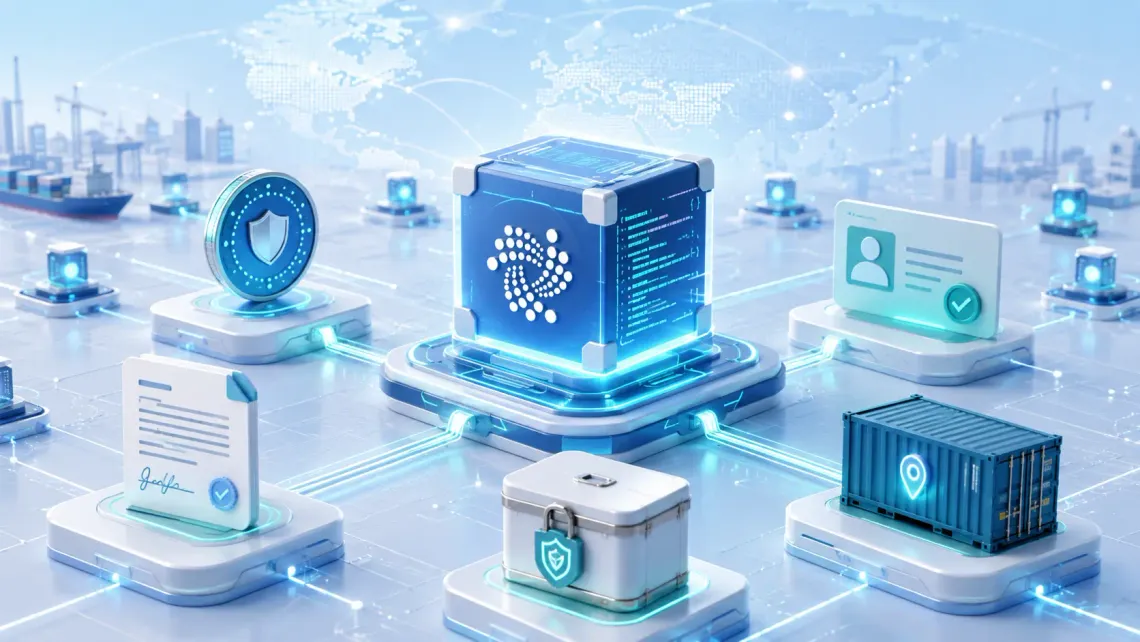
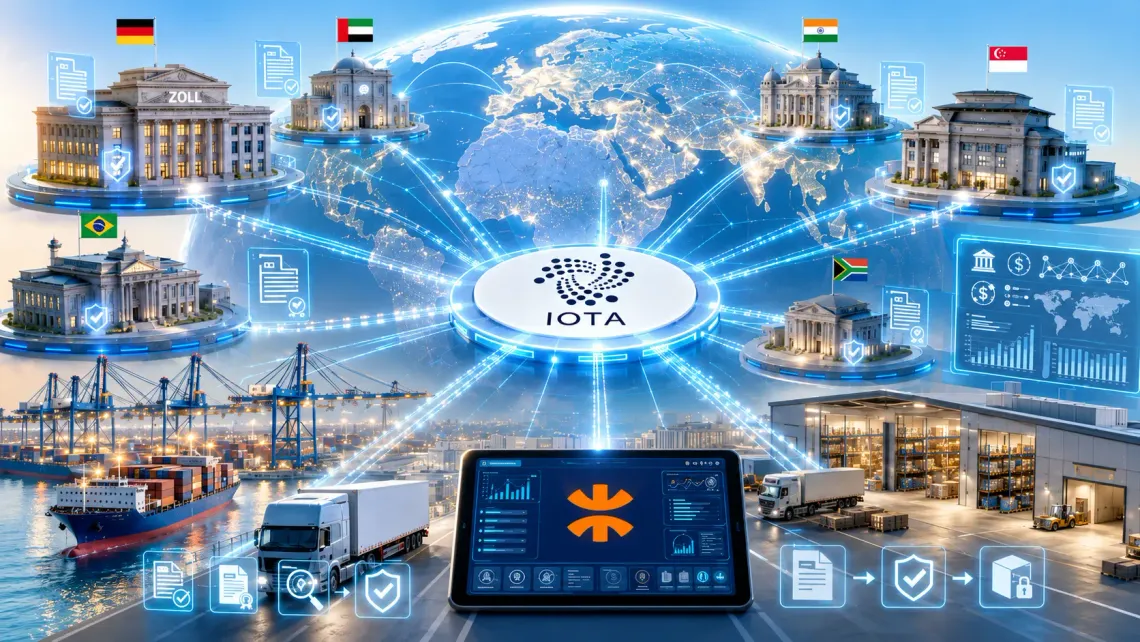
Supplier certificates, quality standards, inspection records, and product compliance documents can be exchanged as verifiable credentials between business partners.
The Lifelong Digital Passport
Turing Space describes a long-term vision of a lifelong passport: a continuous, verifiable record that could follow a person through education, employment, professional training, healthcare, and other important stages of life.
Such a system would require strong privacy protections and careful governance. Not every credential should be visible to every organization, and users must retain control over what they share.
Selective disclosure can allow a person to prove only the information required for a transaction. Instead of revealing an entire document, the holder might prove that a qualification is valid or that a requirement has been met.
Why the Turing Certs and IOTA Integration Matters
The importance of this integration is not that blockchain appears visibly in every user interaction.
Its value lies in providing a neutral verification layer beneath ordinary digital services.
A student can receive a diploma without purchasing tokens. An employer can verify it without calling the university. A regulator can check the integrity of a compliance record without relying on an exported PDF.
IOTA Identity provides the digital identities. IOTA Notarization provides the integrity proof. IOTA Gas Station removes blockchain complexity from the user experience.
Together, these tools help Turing Certs turn documents into portable, machine-verifiable evidence.
Conclusion
Turing Certs and IOTA demonstrate how distributed ledger technology can support practical digital trust rather than cryptocurrency speculation.
By combining decentralized identities, verifiable credentials, notarized proofs, and sponsored transactions, the platform can make certificates easier to issue, carry, and verify across borders.
The result is more than a digital certificate platform. It is an emerging trust infrastructure for education, healthcare, employment, sustainability, compliance, and international business.