IOTA Enters an Official German Legislative Process
IOTA has appeared on the official website of Germany's Federal Ministry of Finance not in a promotional article or cryptocurrency announcement, but within the consultation process for a proposed law strengthening customs administration and the fight against financial crime.
The draft Zollfinanzgerechtigkeitsgesetz is intended to modernize German customs, improve financial investigations, and strengthen the detection of illegal international financial flows under the principle of "Follow the Money."
Among the published responses to the draft is a formal statement from the IOTA Foundation. It appears alongside submissions from banks, legal organizations, trade associations, unions, transparency groups, and other institutions participating in the legislative consultation.
This does not mean that Germany has adopted IOTA or TWIN. However, it does mean that IOTA's position was formally received and published as part of an official legislative procedure.
That is very different from ordinary crypto publicity.
Why Replacing Paper With PDFs Is Not Enough
The IOTA Foundation's argument addresses a fundamental weakness in customs digitization: converting a paper document into a PDF does not automatically create a trustworthy digital process.
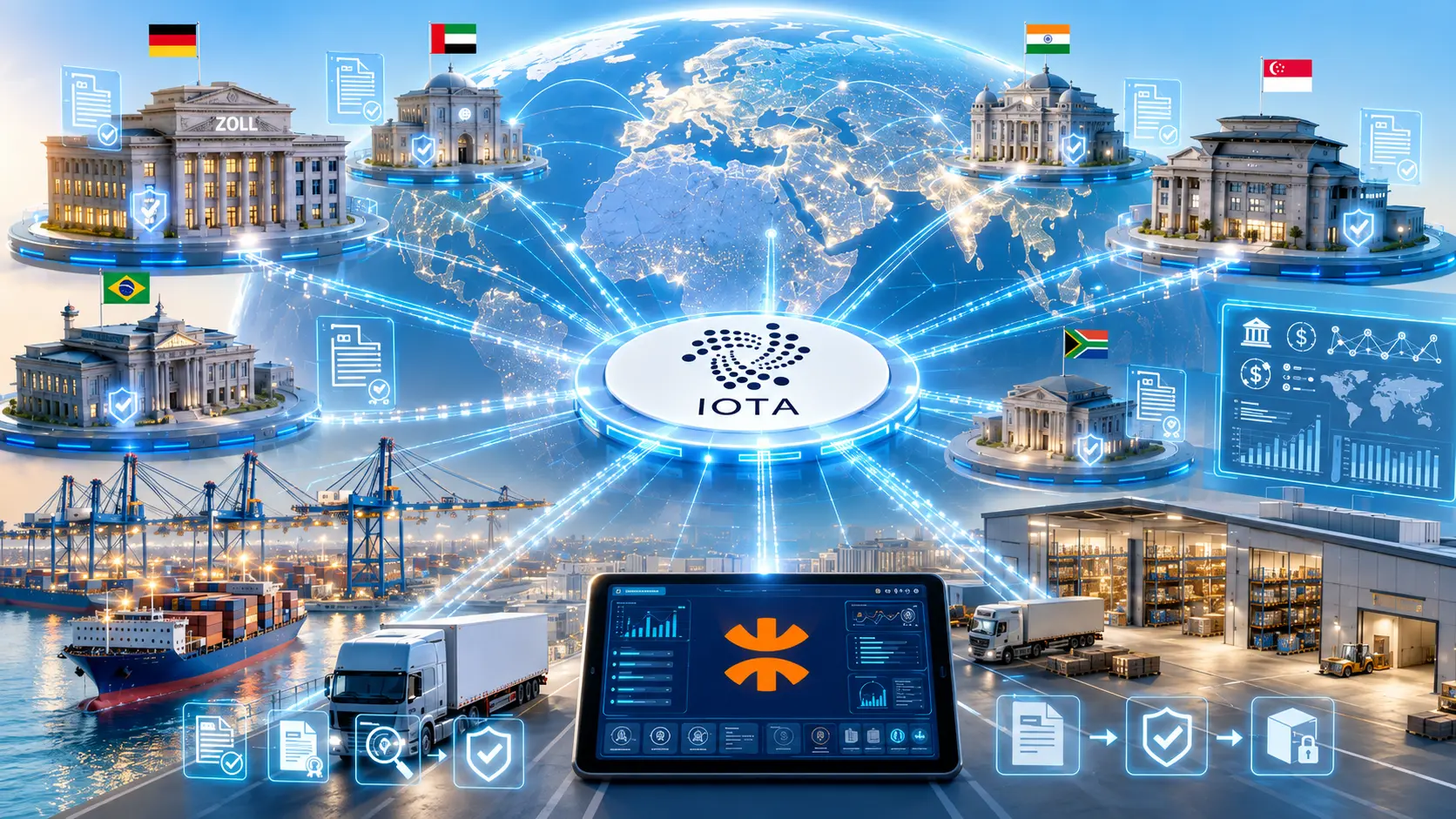
Invoices, transport documents, certificates of origin, customs declarations, and delivery records are exchanged between exporters, logistics providers, financial institutions, border authorities, and importers. Different copies may exist in separate systems, making it difficult to determine where information originated, when it was created, or whether it was changed.
A genuinely digital customs system therefore needs more than electronic documents. It needs a verifiable data layer connecting documents to companies, identities, goods, and logistical events.
Distributed ledger technology can help create this shared layer. Cryptographic signatures, verifiable identities, and tamper-resistant records make it possible to confirm who provided information and how a shipment's history developed.
Where TWIN Enters the Picture
The Trade Worldwide Information Network, or TWIN, is designed as open digital infrastructure for exchanging trade and supply-chain data across organizational and national borders.
Instead of forcing every participant into one central database, TWIN can connect existing systems through interoperable interfaces. Companies and authorities can retain control over their data while sharing the information required for verification, risk analysis, and customs processing.
A shipment could connect its invoice, certificate of origin, transport record, inspection result, customs declaration, and border events within one verifiable history.
For customs authorities, this could make relevant information available before the physical shipment reaches the border. Legitimate cargo could be processed faster, while suspicious discrepancies could be identified earlier.
Fighting Trade-Based Money Laundering
This infrastructure may also support the fight against trade-based money laundering.
Criminal networks can conceal financial flows by manipulating invoices, misrepresenting the value or origin of goods, using complex intermediary structures, or separating financial transactions from the physical movement of cargo.
Traditional systems often store the relevant evidence in disconnected databases and documents. TWIN's proposed model links commercial records to real supply-chain events.
Authorities could compare declared values with documented shipments, identify unusual routing patterns, examine the parties involved, and detect inconsistencies between invoices, certificates, and actual logistics data.
DLT does not automatically prove that every submitted statement is true. Incorrect information can still enter a system. Its value lies in making the origin, sequence, signatures, and later modification of records easier to verify.
Germany Is Only One Part of a Larger Development
The German consultation should not be viewed as an isolated event. Governments and border authorities worldwide face the same structural problems: fragmented customs systems, paper-heavy processes, financial crime, sanctions enforcement, inefficient inspections, and limited visibility across international supply chains.
TWIN emerged from earlier trade digitization work in East Africa and has been tested in trade corridors involving Kenyan exports and European markets. In the United Kingdom, the technology was trialled with government departments and border authorities through the Ecosystem of Trust initiative.
The ADAPT programme represents another major step. Working with the African Continental Free Trade Area ecosystem, it aims to create shared digital public infrastructure for African trade, with initial implementation activity involving Kenya, Morocco, and Nigeria.
The World Economic Forum, TradeMark Africa, the Tony Blair Institute for Global Change, the Chartered Institute of Export & International Trade, and the Global Alliance for Trade Facilitation are also connected to the broader TWIN initiative.
Not every participating organization plays the same role, and involvement does not mean that every government has officially selected IOTA as national infrastructure. Nevertheless, the pattern is becoming increasingly clear: digital trade infrastructure is moving from experimental blockchain projects toward discussions with customs authorities, ministries, trade institutions, and international organizations.
From National Projects to a Shared Global Layer
Every government has its own laws, customs platforms, data requirements, and security policies. A global trade network cannot simply replace all these systems.
Its real opportunity lies in connecting them.
TWIN could serve as a neutral interoperability layer through which trusted trade information moves between national systems without transferring control to one government or commercial platform.
Germany's interest in improving customs analysis and tracing illegal financial flows fits this wider requirement. African governments need better infrastructure for continental trade. The United Kingdom wants more efficient border processes. Exporters need fewer repeated data submissions. Financial institutions need reliable evidence for trade finance and compliance.
Different countries may begin with different objectives, but they increasingly need the same thing: structured, interoperable, and verifiable trade data.
Not Adoption Yet but More Than Crypto Noise
The publication of IOTA's statement by the German Federal Ministry of Finance must be interpreted carefully.
It is not confirmation that Germany will implement IOTA or TWIN. It does not guarantee that the Foundation's recommendations will enter the final law. And it does not establish IOTA as the exclusive technology for German customs.
But it demonstrates that IOTA is participating in a serious policy discussion about customs modernization, financial crime, and international trade data.
The larger story is not that one German ministry mentioned IOTA. It is that similar infrastructure requirements are appearing across governments and trade corridors worldwide.
If TWIN can connect these separate efforts through open standards and verifiable data, IOTA's role could become much larger than that of a conventional blockchain project.
It could become part of the shared digital infrastructure through which global trade is documented, verified, financed, and controlled.